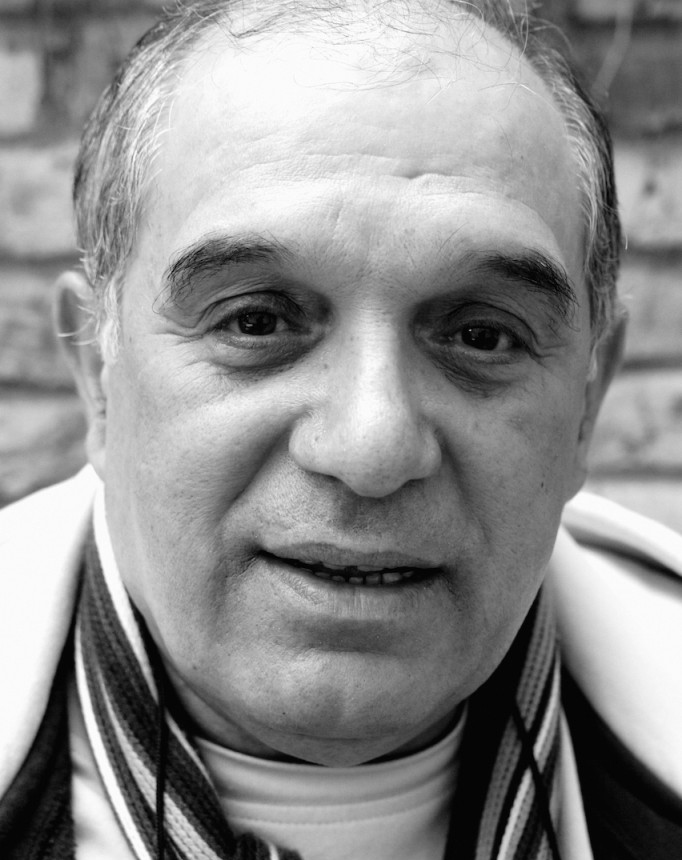
Gejza Horváth was born in Písečná in the Šumperk region, but spent his childhood in the village of Kolinovce near the town of Krompachy, Slovakia. He comes from a family of musicians, who introduced him to music from an early age, and by the age of twelve he was playing with the biggest bands in Slovakia. He worked as a warehouse clerk and, after completing his military service, began playing with a Roma band. However, this was not enough to support his family, so he moved to Brno with his wife and son. He taught accordion at a folk art-school (Lidová škola umění) and opened a musical instrument shop in Brno. From 1980, Gejza Horváth devoted himself to music professionally, founding the band Romano rat, for example. He composed his own songs and collaborated with several Romani ensembles as a composer and lyricist. In the late 1990s, he co-founded the magazine Romano Hangos, where he has worked as an editor. He has contributed to it with socio-political commentary as well as song lyrics and recollections that capture the life and traditions of the Roma living in Slovakia during his childhood and youth.
His work was first published in anthologies and magazines, and in 2006, G+G Publishing House published a collection of fourteen short stories in Czech entitled Trispras. His short stories “Drilko”, “Ďáblové” / “Devils” and “Můj dědeček” / “My Grandfather” were published in Čalo voďi, an anthology of Romani writing from the Czech Republic (Museum of Romani Culture 2007). He has occasionally published his short stories on Facebook and on the Romea.cz website (for example, the short stories “Já a oni” / “Us and Them”, “Dovolená” / “Holiday”, “Já a Vánoce” / “Christmas and I”). Gejza Horváth has been writing mainly in Romani. In 2021, his prose “Já a oni” / “Us and them” was published in the anthology Všude samá krása (Nothing But Beauty Everywhere, Kher, 2021).
In 2017, he received the Museum of Romani Culture Award for his contribution to Romani musical and literary culture, for his ongoing struggle to preserve the Romani language through his journalistic and educational work, and above all for his writing.
Photo: Lukáš Houdek